
Speaker Cable Elevators: What They Are and How They Work
Learn what speaker cable elevators do, why audiophiles use them, and how they help support cleaner cable routing, spacing, and floor contact control.
Speaker Cable Elevators: What They Are and How They Work
Learn what speaker cable elevators do, why audiophiles use them, and how they help support cleaner cable routing, spacing, and floor contact control.
Speaker cable elevators are supports designed to raise speaker cables off the floor while maintaining a more controlled and consistent routing path. In many audio systems they are used to improve cable organization, reduce contact with surrounding surfaces, and help maintain even spacing along longer cable runs.
This guide explains what speaker cable elevators are, how they are commonly used, and where they fit within a two-channel audio system. It also explores related terms such as cable risers and cable lifters, practical placement considerations, and factors to consider when deciding whether they belong in your setup.
Cable Arch™ Original packs are available in 4-Pack, 8-Pack, and 12-Pack options, with the Original 4-Pack starting at $150.
In This Guide
✔ What are speaker cable elevators?
✔ Cable elevators vs cable risers and cable lifters
✔ Why some listeners use cable elevators
✔ Do cable elevators improve sound?
✔ How many cable elevators do you need?
✔ Where should cable elevators be placed?
✔ Real-world applications and setup examples
✔ Related guides and resources
Are Cable Elevators the Same as Speaker Cable Elevators?
Cable elevators and speaker cable elevators usually refer to the same type of audio accessory: a support that lifts speaker cables off the floor and helps maintain a cleaner, more consistent cable path.
The terms cable risers, speaker cable risers, cable lifters, and speaker cable lifters are often used the same way. In high-end audio systems, these supports are typically used to reduce floor contact, improve cable routing, and keep speaker cable runs more evenly positioned. In audiophile systems, these products are also commonly referred to as audiophile cable risers, speaker cable risers, cable lifters, or speaker cable lifters.
What Are Speaker Cable Elevators?

Speaker cables are large, physically present elements of an audio system. In most rooms, they rest directly on carpet, wood, tile, or concrete as they run from amplifier to loudspeaker.
They are most commonly used in two-channel stereo systems, dedicated listening rooms, and high-resolution setups with longer cable runs. Their purpose is not decorative, but functional: reducing floor contact as a variable and maintaining controlled cable geometry over time.
Understanding what cable elevators do — and what they do not do — provides useful context when deciding whether they belong in a given system.
For shorter systems or simple two-channel setups, the Cable Arch™ 4-Pack provides a practical starting point for elevating speaker cables and maintaining a cleaner routing path.
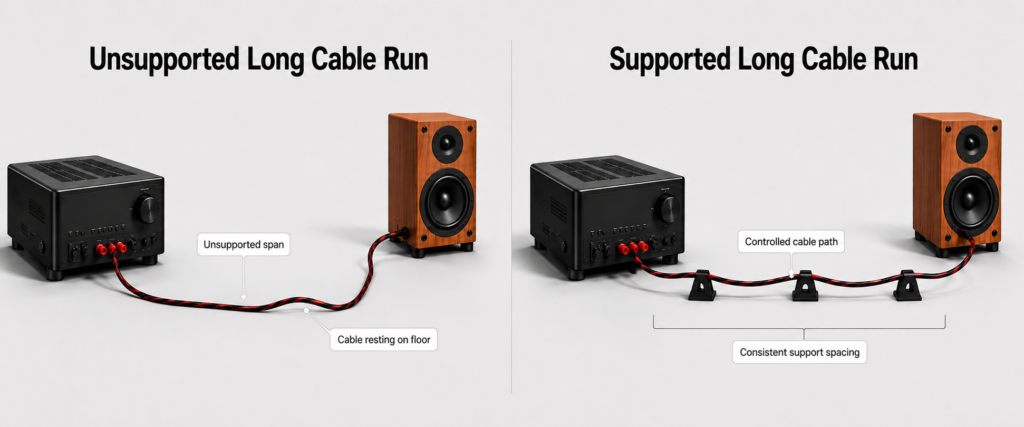
Unsupported vs supported speaker cable runs
Speaker Cable Elevators vs Lifts vs Risers
The terms speaker cable elevator, speaker cable riser, speaker cable lift, and cable lifter are often used interchangeably.
In most cases they describe the same type of accessory: a device that raises speaker cables off the floor and supports a controlled routing path between amplifier and loudspeaker.
The terminology varies by manufacturer, region, and audio community preference. While designs may differ, the basic goal remains the same:
✔ Elevate the cable above surrounding surfaces
✔ Maintain consistent cable routing
✔ Reduce contact with carpet, wood, tile, or concrete floors
✔ Support long or heavy cable runs
For a detailed comparison of terminology and common design differences, see our guide to Speaker Cable Risers vs Cable Elevators.
Speaker Cable Risers vs Cable Elevators: Is There a Difference?
Explore the similarities, terminology, and practical differences between cable risers, cable lifts, cable lifters, and speaker cable elevators.
Read the GuideWhy Do People Use Speaker Cable Elevators?
1. Floor Contact and Environmental Interaction
When speaker cables rest directly on the floor, they are exposed to carpet fibers, dust, debris, foot traffic, pets, and static-prone materials. Elevating the cable separates it from these surfaces and reduces ongoing environmental interaction, keeping the cable’s path stable and repeatable over time.
2. Vibration Management (Mechanical, Not Electrical)
Speaker cables do not generate vibration on their own, but they exist in environments that do. Low-frequency energy from speakers, footfall on suspended floors, and resonance in wood subfloors can all cause cables resting on the floor to shift or settle unpredictably. Cable elevators introduce fixed support points that limit uncontrolled movement and help maintain consistent spacing and geometry along the run. Any effect is subtle and system-dependent, but this principle is one reason cable elevators first appeared in high-resolution listening environments.
3. Static and Material Interaction
Certain flooring materials, particularly synthetic carpeting and dry indoor environments, can accumulate static charge. While speaker cables are insulated and designed for durability, prolonged contact with static-prone surfaces is something some listeners prefer to avoid as part of a conservative system setup approach.
Elevating the cable separates it from materials that may accumulate charge and reduces direct surface interaction along the run. Cable Arch models incorporate a static-dissipative surface treatment at cable contact points to help limit charge buildup while maintaining consistent mechanical support. The goal is not to alter the signal, but to reduce environmental variability around the cable in long-term installations.
4. Cable Routing and Organization
For many systems, the most immediately noticeable benefit is practical and visual. Cable elevators allow clean, intentional routing with even spacing, fewer crossings, and reduced tangling, while making cleaning and maintenance easier.
In dedicated listening rooms, purpose-built cable elevators make cable routing part of the system design rather than an afterthought. Well-designed cable risers support consistent spacing and layout without improvisation.
Do Speaker Cable Elevators Improve Sound?
This is the most common question surrounding speaker cable elevators.
Speaker cable elevators do not amplify the signal, change cable specifications, or alter frequency response. Their purpose is physical cable management rather than electronic signal processing.
Supporters of cable elevators generally point to several potential benefits:
Reduced contact with surrounding floor materials
More consistent cable routing and spacing
Less interaction with dust, debris, and foot traffic
Improved organization of long cable runs
Greater setup consistency over time
Whether these factors produce an audible difference depends on the system, room, cable routing, and listener. Some audiophiles report improvements in highly resolving systems, while others hear little or no change.
For many users, the most immediate benefit is practical rather than sonic. Cable elevators create a controlled routing path that keeps cables elevated, organized, and visually consistent throughout the listening room.
For a deeper discussion of the claims, theories, and real-world experiences surrounding cable elevators, see our guide: Do Cable Elevators Work?
Do Cable Elevators Work? A Practical Guide for Real-World Audio Systems
Explore the common arguments for and against cable elevators, what users report hearing, and the practical reasons many audiophiles use them.
Read the GuideHow Many Speaker Cable Elevators Do You Need?
The number of speaker cable elevators required depends on cable weight, cable flexibility, total run length, and the level of routing control you want to achieve.
For most systems, a practical starting point is placing a support approximately every 18 to 30 inches along the cable run. Heavier or less flexible cables typically benefit from closer spacing, while lighter cables can often span greater distances between supports.
The goal is not to create tension in the cable. Instead, speaker cable risers should support the cable naturally while maintaining a consistent routing path across the floor.
General Guidelines
✔ Light speaker cables: supports every 24–30 inches
✔ Medium-weight speaker cables: supports every 18–24 inches
✔ Heavy audiophile cables: supports every 12–18 inches
✔ Long cable runs: additional supports help maintain consistent spacing and reduce sag
Every system is different, but maintaining even support spacing generally produces the most organized and predictable cable routing.
Rule of Thumb
Most systems benefit from support spacing of approximately 18–30 inches. Heavier or less flexible speaker cables typically require closer spacing to maintain a consistent cable path.
Cable Arch supports are available in multiple pack sizes to accommodate different cable run lengths and system layouts.



Where Should Speaker Cable Risers Be Placed?
Speaker cable risers should support the cable naturally while maintaining a consistent routing path between amplifier and loudspeaker.
For many listeners, audiophile cable risers are most useful in longer cable runs where consistent support, spacing, and routing control are harder to maintain.
A common approach is to place the first support a short distance from the amplifier, continue with evenly spaced supports throughout the run, and position the final support near the speaker terminals. The exact spacing depends on cable weight, flexibility, and overall run length.
Placement Guidelines
✔ Start a short distance from the amplifier
✔ Maintain consistent spacing throughout the run
✔ Support heavier cables more frequently
✔ Avoid sharp bends or excessive tension
✔ Keep left and right channel routing similar when practical
The goal is not to force the cable into a perfectly straight line. Instead, supports should create a controlled, repeatable cable path while allowing the cable to rest naturally between support points.
For additional routing guidance, see our guide on Speaker Cable Routing Best Practices for Two-Channel Audio Systems.
Are Speaker Cable Elevators Worth It?
Speaker cable elevators can be worth considering if your system has long cable runs, heavy speaker cables, visible cable clutter, or a listening space where clean presentation matters.
Their most reliable benefits are practical:
✔ Cleaner speaker cable routing
✔ More consistent cable spacing
✔ Reduced contact with flooring surfaces
✔ Better support for long or heavy cable runs
✔ A more organized and intentional system layout
For listeners expecting a dramatic sonic transformation, cable elevators may not be the first upgrade to prioritize. They do not change the cable itself, amplify the signal, or replace proper speaker placement, room setup, or component matching.
Where they make the most sense is in systems where cable layout is already part of the overall setup strategy. In those cases, speaker cable elevators can help maintain a cleaner cable path, reduce floor contact, and support a more refined visual presentation.
For a deeper look at the practical and sonic arguments, see Do Cable Elevators Work? A Practical Guide for Real-World Audio Systems.
Speaker Cable Elevators in Real-World Systems
In practice, cable elevators are often used alongside equipment isolation, dedicated audio racks, careful speaker placement, and thoughtful room layout. They are one of several small decisions that contribute to an intentional system design. For a system-based discussion of when cable elevators make a difference and when they don’t, see Do cable elevators work?
From Theory to Implementation
Understanding what speaker cable elevators are and how they function provides useful context, but implementation ultimately depends on system layout, cable type, and room conditions. In practical terms, properly spaced speaker cable elevators create a controlled routing path that keeps cables elevated, stable, and visually organized.
For systems using single speaker cable runs, purpose-built speaker cable elevators such as Cable Arch™ provide evenly spaced mechanical support. For bi-wire or parallel cable configurations, dual-channel cable elevators like Cable Arch™ Duo maintain separation and symmetry while simplifying routing.
Implementation should support the system naturally, without forcing tension or artificial positioning along the cable run.
Final Thoughts
Speaker cable elevators are designed to support a more consistent and controlled cable path between amplifier and loudspeaker. While opinions vary regarding audible effects, many listeners use them for practical reasons such as cable management, support of long cable runs, reduced floor contact, and improved system organization.
Whether referred to as speaker cable elevators, cable risers, cable lifts, or cable lifters, the basic objective remains the same: maintaining an elevated and organized routing path throughout the system.
If you’re evaluating whether cable elevators belong in your setup, the most useful approach is to consider your cable length, cable weight, room layout, and overall installation goals.
For additional information, explore:
- Speaker Cable Risers vs Cable Elevators: Is There a Difference?
- Do Cable Elevators Work? A Practical Guide for Real-World Audio Systems
- Speaker Cable Routing Mistakes to Avoid in High-End Audio Systems
- Speaker Cable Routing Best Practices for Two-Channel Audio Systems
- Cable Arch Duo Dual-Channel Speaker Cable Supports