

Speaker Cable Routing Best Practices for Two-Channel Audio Systems
Speaker cable routing is often one of the last steps in assembling a two-channel audio system, yet it can have a significant impact on organization, usability, and overall system presentation.
While cable routing can be accomplished in many ways, some listeners use speaker cable elevators to help maintain a more consistent cable path and support spacing.
In This Guide
✓ Avoid large cable piles
✓ Maintain a consistent cable path
✓ Support long cable runs when appropriate
✓ Separate speaker cables from power cords when practical
✓ Focus on organization and installation quality
Most systems begin with a focus on speakers, electronics, room placement, and acoustic considerations. Once those decisions are made, the remaining task is connecting everything together. Without a plan, speaker cables can quickly become one of the most visible sources of clutter in an otherwise carefully assembled system.
Good cable routing is not about creating perfectly straight lines or making a system look artificial. Instead, it is about establishing a deliberate path between amplifier and speaker while maintaining consistency throughout the installation.
Whether a cable run is six feet or twenty feet long, the same principles generally apply:
- Follow a planned routing path
- Avoid unnecessary loops and excess slack
- Maintain consistent cable spacing where practical
- Support longer cable runs when appropriate
- Keep the installation organized and easy to maintain
The result is a cleaner system that is easier to service, easier to clean around, and more visually cohesive.
Why Routing Matters
Many listening rooms evolve over time.
Equipment is moved. Speakers are repositioned. New components are added. Cable lengths change. What begins as a temporary arrangement can gradually become a collection of excess cable, inconsistent routing, and unnecessary clutter.
A well-planned cable path helps avoid this situation by creating structure from the beginning.
Rather than allowing cables to take the shortest or most convenient path across the floor, a deliberate routing approach establishes a consistent route between components. The objective is not perfection. The objective is organization, repeatability, and control.
Long cable runs particularly benefit from this approach because small routing inconsistencies become more noticeable as distance increases. Maintaining a controlled path helps keep the installation visually balanced while reducing the tendency for cables to drift, bunch together, or accumulate in unintended areas.
The illustration below demonstrates a typical long speaker cable run using consistent support spacing and a deliberate routing path.
For systems where cable management is a priority, Cable Arch can help maintain consistent cable spacing while keeping cables elevated above the floor.
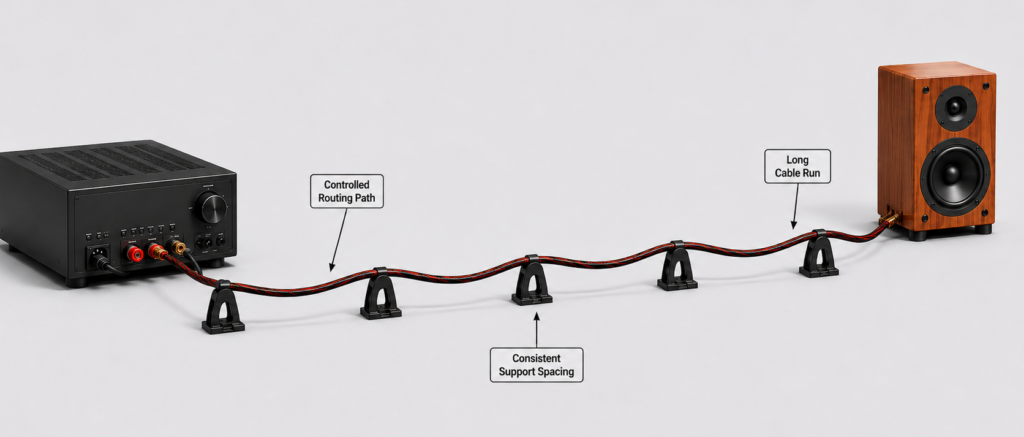
Long Cable Run Example
Figure: Long Speaker Cable Run Using Consistent Support Spacing
In this example, the speaker cable follows a predictable path from amplifier to speaker while maintaining smooth bends and consistent support intervals.
The exact spacing between supports is less important than maintaining a repeatable routing pattern. The goal is to prevent excessive sagging, avoid random changes in direction, and create a cable path that remains organized throughout the length of the run.
This same approach can be applied to short cable runs, long cable runs, speaker cables, interconnects, and other system wiring where organization and consistency are priorities.
Longer runs often benefit from multiple support points. Many installations use a Cable Arch 8-Pack or Cable Arch 12-Pack to maintain consistent spacing across the entire route.
Cable Arch™ speaker cable risers help maintain consistent cable spacing and routing while reducing contact with flooring surfaces.
Cable Arch™ speaker cable risers help maintain consistent cable spacing and routing while reducing contact with flooring surfaces.
View Cable Arch ProductsKeeping Speaker Cable Runs Consistent
Consistency is often more important than achieving perfectly straight cable runs.
In most listening rooms, speaker cables must navigate around furniture, equipment racks, walkways, and room boundaries. A perfectly straight path is rarely practical. Instead, the objective is to establish a routing pattern that remains deliberate and predictable from amplifier to speaker.
A consistent cable path helps create visual order throughout the system while making future maintenance easier. When cables follow a repeatable route, they are less likely to drift out of position, develop unnecessary loops, or accumulate excess slack over time.
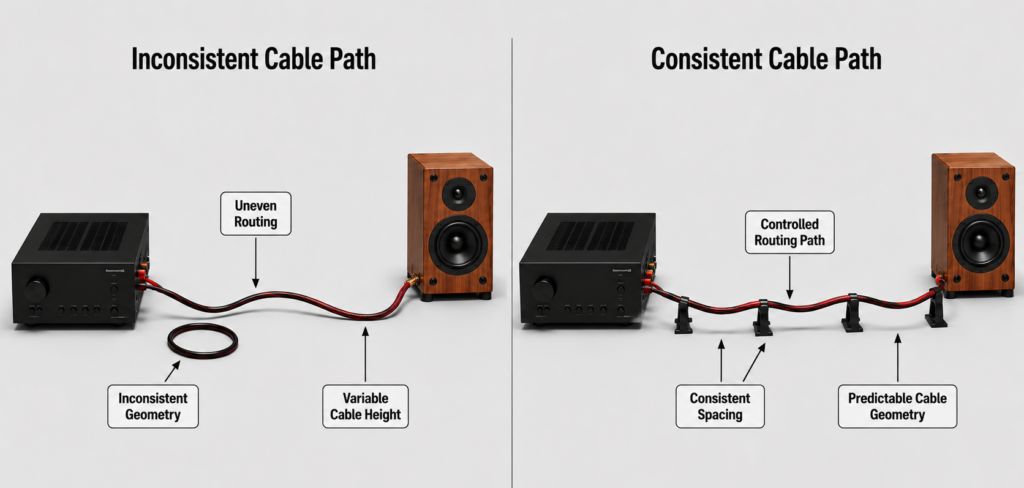
The comparison above illustrates the difference between a cable run that developed without a clear plan and one that follows a more intentional routing strategy.
The inconsistent example contains uneven bends, varying cable height, and irregular routing. While the system remains functional, the cable path appears less organized and can become more difficult to manage as additional equipment is added or components are repositioned.
The organized example follows the same general route while maintaining smoother transitions and more consistent spacing. The goal is not to force the cable into a perfectly straight line. Instead, the goal is to create a predictable path that is easy to understand, easy to maintain, and visually cohesive.
When evaluating your own system, consider:
- Are cable bends generally smooth and consistent?
- Does the cable follow a deliberate route between components?
- Is excess slack minimized?
- Is cable height reasonably consistent throughout the run?
- Are support points placed at logical intervals?
Small improvements in these areas can often have a larger impact on overall system organization than many equipment upgrades or cosmetic accessories.
Whether the cable run is short or long, maintaining a consistent routing strategy helps create a cleaner and more intentional installation that complements the rest of the system.
Separating Speaker Cables from Power Cords
Modern audio systems often contain multiple cable types running through the same area. Speaker cables, power cords, interconnects, Ethernet cables, and USB cables can quickly become difficult to organize if they all follow the same path across the floor.
The goal is not perfection. The goal is creating a routing plan that remains organized, easy to maintain, and visually consistent as a system evolves over time.
When multiple cable types share the same route, it becomes more difficult to identify individual cables, perform equipment changes, and maintain a clean system layout. Cables can cross unnecessarily, become tangled during equipment moves, or create visual clutter behind racks and speakers.
By assigning separate routing paths to different cable types, many of these organizational challenges become easier to manage.
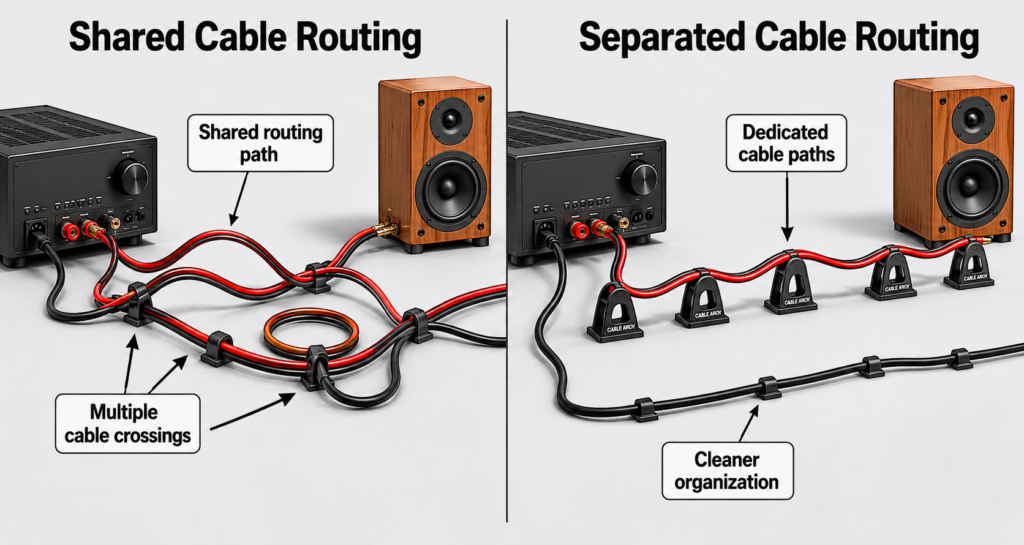
Example of shared cable routing compared to a more organized approach using dedicated cable paths.
Creating Dedicated Cable Paths
A simple approach is to establish a dedicated path for speaker cables while allowing power cords to follow a separate route nearby.
Benefits can include:
- Easier cable identification
- Reduced cable crossings
- Cleaner overall system appearance
- Simpler equipment maintenance
- More predictable routing throughout the system
In larger systems, dedicated routing paths can also make future upgrades easier because individual cables can be traced and adjusted without disturbing the rest of the installation.
The objective is not necessarily to increase complexity, but to create a layout that remains organized and intentional over the long term.
Separating Speaker Cables from Power Cords
Most systems contain speaker cables, power cords, interconnects, Ethernet cables, and USB cables running through the same area.
Maintaining an organized layout helps prevent cables from becoming tangled or difficult to identify later.
When possible:
- Route speaker cables separately from power cords
- Avoid large bundles of mixed cable types
- Keep cable paths easy to follow
- Label cables in more complex systems
The goal is not perfection but a layout that remains organized as equipment changes over time.
Supporting Heavy Speaker Cables
Modern speaker cables range from lightweight wire to large, heavily insulated designs.
Heavier cables can sometimes sag, shift position, or place stress on connectors depending on the installation.
Supporting the cable at intervals can help maintain routing consistency while reducing strain caused by unsupported cable weight.
The amount of support required depends on cable diameter, weight, and overall run length.
Heavy-gauge cables can place additional load on unsupported spans. Properly spaced speaker cable risers can help maintain a more controlled cable path.
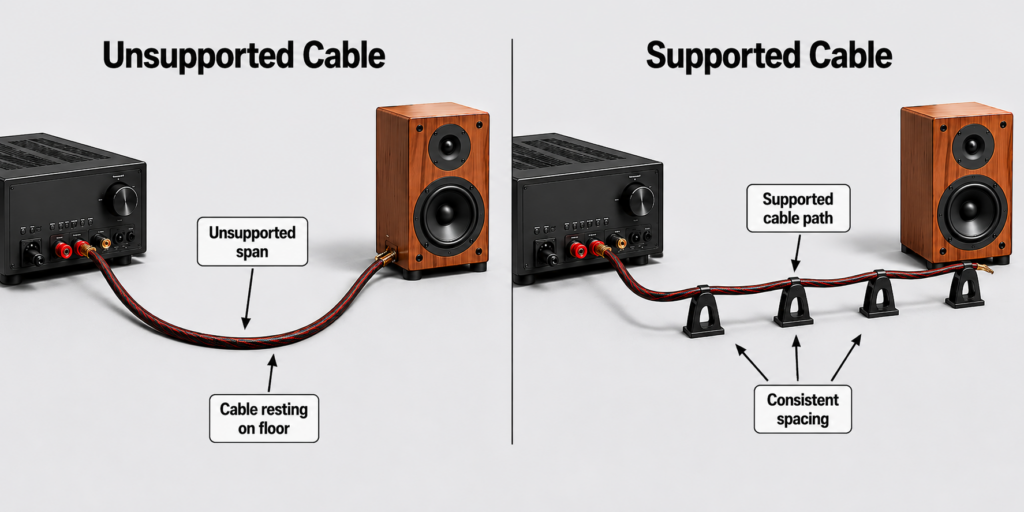
Example of an unsupported cable run compared to the same cable using evenly spaced support points.
Why Support Points Can Be Helpful
Support points can help maintain a more predictable cable path by reducing long unsupported spans between equipment.
Potential benefits include:
- More consistent cable positioning
- Reduced sagging over longer distances
- Cleaner overall presentation
- Easier routing around equipment and furniture
- Better long-term cable organization
The amount of support required depends on cable diameter, weight, flexibility, and overall run length. Some systems may require only a few support points, while heavier cables may benefit from more frequent spacing.
Consistency Matters More Than Quantity
The goal is not necessarily to use the greatest number of supports possible.
In many systems, maintaining reasonably consistent spacing and a smooth routing path is more important than the exact number of supports used.
A simple, repeatable routing plan often produces a cleaner and more organized installation than allowing a cable to follow an uncontrolled path across the floor.
When evaluating cable support, focus on maintaining a deliberate routing path that remains consistent from one end of the system to the other.
Good cable routing is primarily about organization, consistency, and installation quality—not making exaggerated performance claims.
Example Cable Arch Placement
After considering routing paths, cable separation, and support spacing, the final step is simply applying those principles in a practical system.
There is no single correct placement pattern. Room layout, equipment position, cable length, and cable weight will all influence the final routing path. The goal is not perfection, but rather creating a routing plan that remains organized, repeatable, and easy to maintain.
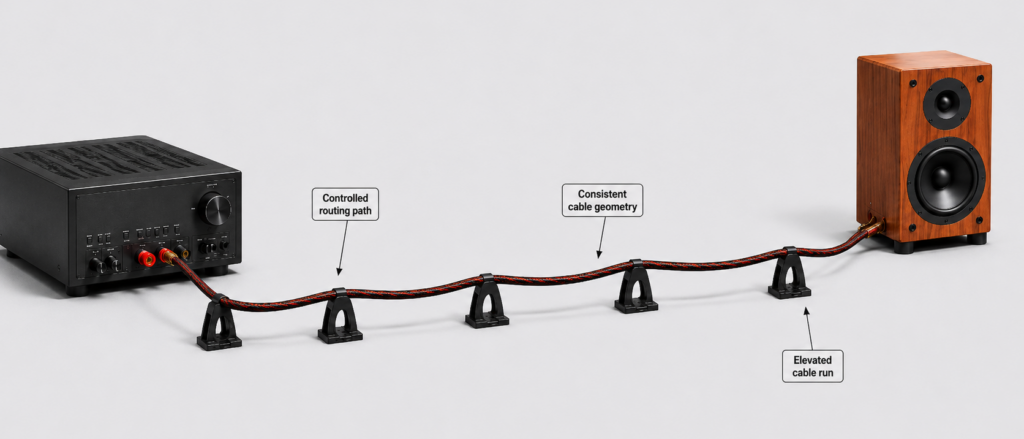
Example of a typical amplifier-to-speaker cable run using evenly spaced support points and a controlled routing path.
See the complete range of Cable Arch speaker cable elevators for different cable lengths and system layouts.
Establishing a Consistent Routing Path
A common approach is to route the cable along the most direct practical path between amplifier and speaker while maintaining smooth bends and reasonably consistent spacing between support points.
When planning a cable path:
- Avoid unnecessary twists or loops
- Use smooth, gradual direction changes
- Maintain reasonably consistent support spacing
- Keep the routing path easy to follow
- Allow access for future equipment changes
The exact spacing between supports is often less important than maintaining a deliberate and consistent routing pattern throughout the run.
Adapting to Your Room
Every listening room presents different challenges. Furniture placement, equipment racks, room dimensions, and cable lengths all influence how a cable can be routed.
Some systems may require only a few support points, while longer runs may benefit from additional supports to maintain a consistent cable path. The objective is to create a layout that works naturally within the room while keeping the installation organized and visually clean.
Whether using cable risers, cable elevators, or other cable management solutions, the underlying principles remain the same: maintain a consistent routing path, minimize unnecessary clutter, and create a system that is easy to understand and maintain over time.
Final Thoughts

Speaker cable routing may not be the most exciting part of building a two-channel audio system, but it can have a meaningful impact on organization, usability, and overall presentation.
By focusing on routing consistency, cable separation, support spacing, and long-term organization, it is possible to create a cleaner and more intentional installation that complements the rest of the system.
The goal is not simply to keep cables off the floor. The goal is creating a deliberate signal path that remains organized, consistent, and easy to manage as your system evolves.
For a deeper explanation of the concept, see our guide to speaker cable elevators: what they are, how they work, and when they matter.